
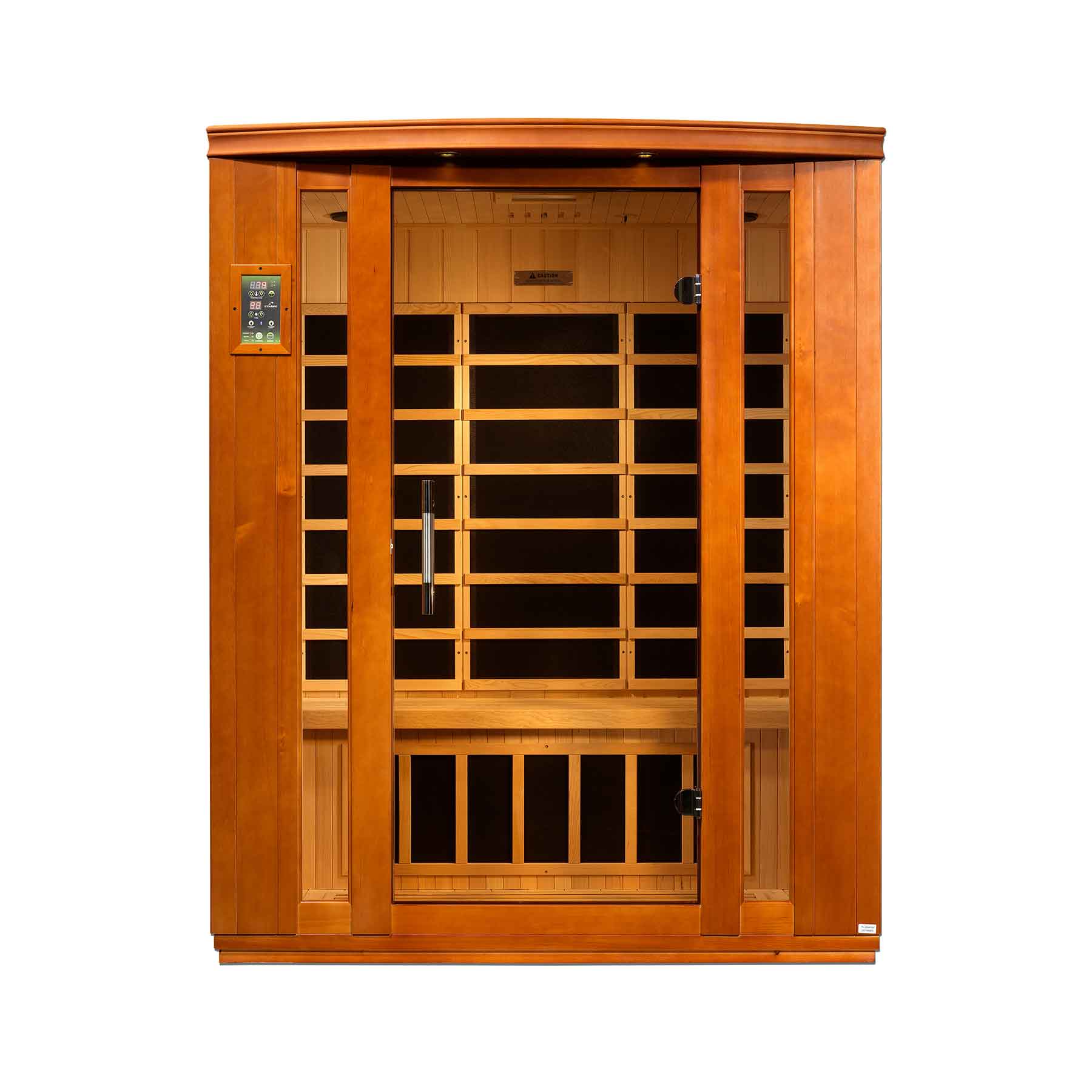
Most sauna benches meet the wall at a right angle, so after a few minutes you're either sitting bolt upright or slumping against flat boards. The short answer: a sauna backrest is a slatted wooden support that stands on the bench against the wall and gives you an angled, contoured surface to lean on. It makes sessions more comfortable and lets you sit back and relax. It isn't a medical device, and a session shouldn't get longer just because you're comfier.
What Is a Sauna Backrest?
A sauna backrest is a free-standing support you place on the bench, between your back and the wall. Most are made from the same untreated softwoods as the sauna itself, usually hemlock or cedar, with slats so air and heat can move through. Shapes range from a simple angled frame to an S-curve that follows your lower back.
Many sauna cabins don't come with one. Dynamic's owner's manuals, for example, note that backrests are sold separately, so it's worth checking what's in the box before you assume your sauna includes them.
What a Backrest Does (and Doesn't Do)
- A better recline. The angle lets you lean back instead of sitting straight against a 90-degree wall, which most people find far more comfortable for a 15 to 30 minute session.
- Support for your lower back. A contoured backrest fills the gap between your lower back and the wall, a bit like a lumbar curve on an office chair.
- A gap between you and the wall. Slats keep your skin off the wall boards and let air move behind your back, so you don't end up pressed against one damp, hot spot.
- Less sweat on the walls. Wall boards absorb sweat and darken over time. A backrest you can lift out and wipe takes most of that contact instead.
What it won't do: a backrest doesn't change how your body responds to heat, and there's no good evidence that it treats back pain or improves recovery. If you have back problems, it may simply make sitting more comfortable; check with your doctor about heat use if you have a medical condition.
Backrests in Infrared vs Traditional Saunas
In a traditional sauna, a backrest is mostly about comfort and keeping you off hot wall boards near the upper benches.
In an infrared sauna, the back wall usually holds heater panels right behind where you sit. A wooden backrest sits between your back and that panel, so you'll feel a little less direct heat on your back, more so with a solid design and less with an open, slatted one. If you like strong heat on your back, choose a slatted backrest and sit in it for a session before deciding whether you want one in every seat.
Cedar, Hemlock or Something Else?
| Material | What to know |
|---|---|
| Western red cedar | Classic sauna wood with a noticeable aroma when warm. Naturally resistant to moisture and decay. Darker color hides sweat marks better. |
| Hemlock | Light color, little or no scent, a good choice if strong smells bother you. Matches most hemlock infrared cabins. |
| Other softwoods (spruce, aspen, basswood) | Common in traditional saunas; aspen and basswood are low-aroma options. |
| Plastic or painted wood | Avoid. Use untreated wood in a sauna, since finishes and plastics can soften or give off odors in the heat. |
Matching the backrest wood to your sauna's interior keeps the look consistent. Our guide to the best wood for a sauna compares these woods in more detail.
How to Choose the Right Sauna Backrest
- Measure your bench. Check bench depth and the height of the wall behind it. A backrest takes up a few inches of seat depth, which matters in compact 1 and 2 person cabins. Our sauna sizing guide lists typical bench depths.
- Pick the shape. An S-curve gives the most lower-back support; a straight angled frame is simpler and lighter.
- Check it won't touch a heater. Nothing should cover or press on an infrared panel or a sauna stove guard. Leave the clearance your manual asks for.
- Look for rounded edges and hidden fasteners. Exposed metal screws get hot, so the best backrests hide them or recess them below the surface.
- Think about how many. One per seat you use regularly; they're easy to lift out when you have guests.
How to Use and Care for a Backrest
- Sit on a folded towel and, if you like, drape a second towel over the backrest. Our guide to what to wear in a sauna covers the towel routine.
- After each session, lift the backrest out and let it air-dry outside the sauna or with the door open.
- Clean it like the rest of the sauna: plain water and a soft damp cloth, with no chemical cleaners (infrared manuals warn that cleaners soak into the wood and come back out in the heat). See how to clean a sauna for the full routine.
- Light sanding with fine sandpaper lifts sweat marks from bare wood. Don't varnish or oil it.
Being comfortable makes it tempting to stay longer, so keep to sensible session times: our sauna session time and safety guide has the details. Backrests are one of several small add-ons that make a home sauna nicer to use; our sauna accessories guide covers the rest.